
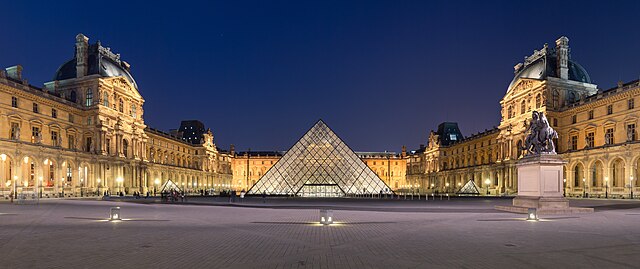
It was an act of breathtaking audacity, like the perfect scene from a Hollywood thriller. On the morning of October 19, 2025, at the Louvre's opening time, four masked people used a mechanical ladder mounted on a vehicle to gain access to the Galerie d'Apollon - the magnificent hall housing the French Crown Jewels. In just a few minutes, reportedly between four and seven, they used angle grinders to break open two display cases, stole priceless historical treasures and fled on scooters. The world marveled not only at the theft itself but also at its perfect execution.
According to INTERPOL, eight of the stolen objects are still missing. Among the stolen treasures are the diadem and necklace of Empress Eugénie, 19th-century pieces adorned with thousands of diamonds and emeralds. The material damage is estimated at approximately 88 million euros; the cultural loss is immeasurable. The authorities' reaction was marked by shock and admissions of failure. French Justice Minister Gérald Darmanin summed it up: "What is certain is that we have failed." Louvre Director Laurence des Cars conceded that the robbery was not inevitable and pointed to serious security gaps such as outdated camera systems and inadequately secured windows. As a consequence, Cultural Minister Rachida Dati announced plans to secure the streets around the museum with anti-ramming barriers.

Photo: Diadem of Empress Eugénie
While the official world mourned the cultural loss, a completely different reception began in the echo chambers of the internet. Here, the robbery was celebrated not as a tragedy, but as a spectacle - a rel-life "Ocean's Eleven" moment that blurred the lines between crime and art form. On platforms like Tiktok and X, videos and comments spread that portrayed the perpetrators not als criminals, but almost as folkloric heroes. The focus was not on the loss, but on the aesthetic staging of the act: the cinematic scissor lift, the escape on scooters, the deliberate humiliation of a symbol of state power. As Süddeutsche Zeitung notes in an article about the media's reception of crime, spectacular thefts often become projection surfaces for longing to break free from the bourgeois order. Users don't celebrate the theft itself, but rather the narrative of invulnerability and the dismantling of an institution perceived as all-powerful. But what lies behind this collective fascination? The French sociologist Pierre Bourdieu might argue that the Louvre is not just a museum, but a temple of cultural capital. It is a place that cements social hierarchies, tastes and power. A robbery in this hallowed hall is therefore more than a property crime; it is a symbolic attack on the established order itself. The act implicitly oses the questions: Who owns culture? Who has the right to guard this welath? The key understanding lies in combining Bourdie's theory of symbolic capital with Baudrillard's analysis of the spectacle: the robbery is both a real blow against an institution and a medially constructed event that caters to our secret desire to see the symbols of power tremble.
The Louvre robbery thus raises more fundamental questions than just those concerning museum security. When cultural heritage, even in its supposedly safest custody, becomes a pawn in such an act, the question inevitably arises: Who does this heritage truly belong to? Our fascinations with the "perfect heist", in turn, reveals much about our modern attitude toward authority, property, (post-)coloniality and justice - a mixture of distrust of institutions and a secret admiration for those who challenge them. The boundaries become blurred: When does crime cease to be perceived as such and become, in the public consciousness, a symbolic act of rebellion? Ultimately, one must ask themselves what lessons society should draw from this twofold vulnerability - both the physical vulnerability of the symbols themselves and their position in the collective conciousness.