
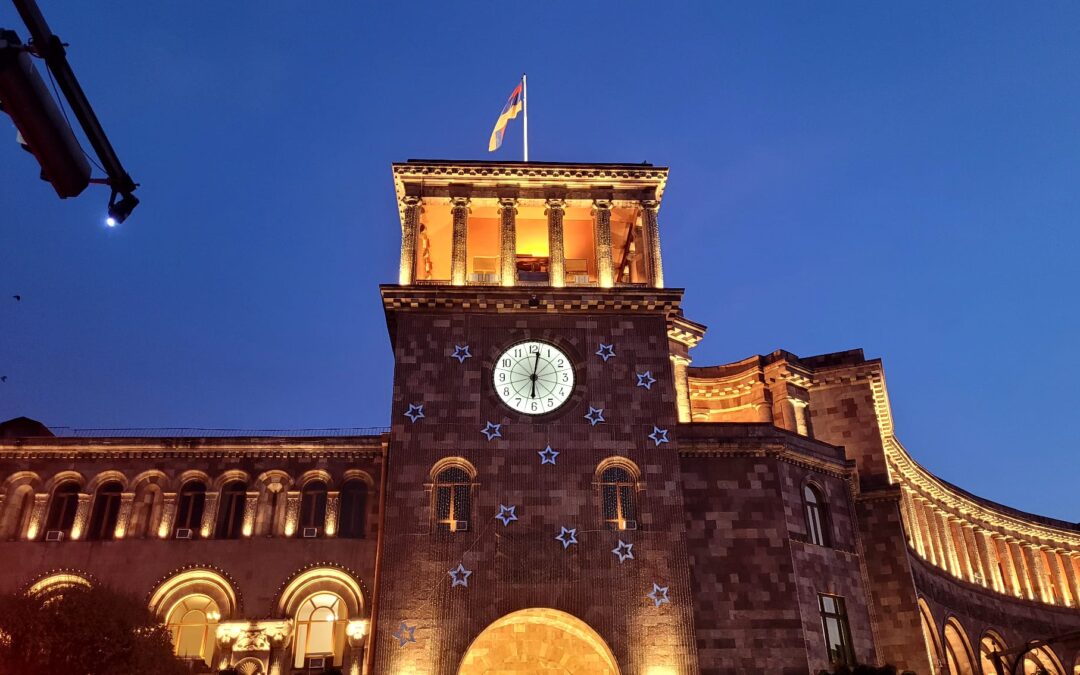
The "Government House" in Armenia's capital Yerevan - residence of Prime minister Nikol Pashinyan.
A fragile democratization, a fragile peace process, and a fragile foreign-policy re-maneuvering: Seven years after the Velvet Revolution and times of crisis, Armenia finds itself in the midst of several major transformations and is soon to face parliamentary elections, with crucial meaning for the reform processes it has initiated. While Prime Minister Pashinyan is pursuing remarkable efforts toward emancipation from Russia and normalisation with Armenia’s neighbors, he faces immense backlash at home. And while the legacy of the 2018 democratic revolution was, and continues to be challenged from the outside, it is also being challenged from within. This is not only due to the potential comeback of the former ruling elite in the upcoming elections, but also because of Pashinyan's own seemingly growing intolerance toward his critics.
In April 2018 after weeks of demonstrations and civil disobediences, protesters finally prevailed and the autocratic President Sargsyan was forced to resign. This was a watershed moment in Armenia's history, as it toppled a long-standing authoritarian regime and a rare case of successful democratization through peaceful grassroots protests. The leader of the "Velvet Revolution", Nikol Pashinyan, rose to center of power after his party's victory in the first truly democratic parliamentary elections since Armenia's independence. Since then, seven years have passed and Armenia, once characterized by “neo-feudal”, oligarchic structures, has become a (semi-)democratic state. But the country has also undergone a multitude of crises and existential threats, above all its defeat in the 2020 Karabakh war and the complete loss of the territory to Azerbaijan in 2023. From the very beginning, Pashinyan’s time in government were marred by immense challenges and intense domestic pressure. Not only in view of the high democratic expectations, gradually given way to growing disillusionment, but later also due to anger over his politics in the Karabakh conflict, as well as increasing Russian attempts to influence his political course. Today, a majority of Armenians appear to oppose him, yet Pashinyan could still achieve something of historic significance in several respects.
Armenia’s Path Toward the West?
Armenia's geographical position is extremely unfavourable. Challenged not only by its landlocked location, it is also surrounded by hostile, historical rivals, Turkey and Azerbaijan, which are more powerful and also enjoy greater geopolitical leverage, being courted by the West for economic and strategic reasons. Another neighbor, Iran, does maintain historically close ties with Armenia, but is hardly a truly advantageous partner due to its autocratic and internationally isolated status. Moreover, in light of Azerbaijan’s neo-patrimonial dictatorship and Georgia’s autocratic development, Armenia suddenly finds itself completely alone with its democratic ambitions in the South Caucasus - and even within a radius of about a thousand kilometers.
Under Pashinyan's leadership, Armenia currently seems to be moving away from its traditional ally Russia and closer to the West and the EU. Although increasingly applauded there, this “path to the West” is less unambiguous and more complicated than it first appears. The 2018 revolution itself was less about a new orientation toward the West and Pashinyan initially continued Armenia’s foreign policy course, proving to be a reliable partner for Putin despite his democratic ambitions. In the 2021 elections, Putin is said to have refrained from intervening more strongly to support the pro-Russian candidate Kocharyan. It was only later, after Armenia’s protector Russia, had sided more with Azerbaijan and launched its full-scale invasion of Ukraine, that relations began to deteriorate. Russia’s refusal to fulfill its security obligations under the CSTO and to protect Armenia’s borders from multiple incursions by Azerbaijan in 2021 and 2022 marked the bitter end of a long-standing paradigm: The belief that closer integration into Russia’s sphere of influence would guarantee Armenia’s security, a rationale that had led the country to join the Eurasian Economic Union in 2013 and abandon negotiations on an Association Agreement with the EU.
In this view, Pashinyan’s foreign policy seems pragmatic and less ideological, driven by the need to strategically “diversify” Armenia’s external and security structures. At the beginning of January 2025, Armenia not only signed a strategic partnership with the US but is also seeking increased cooperation with China and India. Meanwhile, Pashinyan has repeatedly voiced strong criticism of Russia and has both taken and announced various steps signalling a more distant relationship with Moscow and a gradual emancipation from its sphere of influence. These include the decision to join the International Criminal Court in 2023, the withdrawal of Russian border guards from Armenia’s borders with Turkey and Iran, as well as steps toward withdrawing from the CSTO and accusations that Russia is waging a hybrid war against Armenia. After confrontational statements, more conciliatory tones followed: Pashinyan stated that relations with Russia were undergoing a transformation but were ultimately meant to be strengthened. His attendance at Victory Day celebrations in Moscow in May or a following visit to Yerevan by Russian Foreign Minister Lavrov were hardly the images one would expect from a pro-Western government, currently undertaking an alleged turn away from Russia. It shows that Armenia’s course is not a radical shift or a complete break, but rather a series of cautious steps, yet perhaps the maximum achievable given the realities it faces. Not only the economic dependence as a member of the Eurasian Economic Union is tremendous, with around 40% of its foreign trade tied to Russia, which also continues to maintain a strong military base in Armenia’s second-largest city, Gyumri. This seemingly ambiguous approach must also be understood in the context of broader geopolitical power shifts in the South Caucasus, such as growing tensions between Azerbaijan and Russia, the EU’s weak role in the region, but also the unreliable stance of Trump toward Putin.
A Historic Turn toward the EU
While cooperation with the West is by no means new for Armenia, particularly with France as historically important partner, the current rapprochement with the EU represents a remarkable development. A law adopted this March seeking to launch an EU accession process marked a historic step and later in July, Pashinyan explicitly declared his commitment to EU membership. In November, the EU rewarded Armenia with a roadmap for visa liberalization. However, many questions remain as to whether Armenia's ambitions for EU membership really go beyond symbolic gestures and election campaign signals. In any case, the obstacles are immense in every respect, reaching from the country’s geographical isolation, deepened by the suspension of Georgias EU candidacy, to persistent security vulnerabilities and renewed warnings from Russia. Yet the challenges also lie within Armenia itself, with urgently needed reforms still pending and society appearing divided over the country’s European future. Although the EU is generally perceived positively, as reflected in a successful petition that led to the adoption of the EU law, there is also growing distrust toward the EU, likely due in part to its inaction following the displacement of the Karabakh Armenians in 2023. Compared to neighbouring Georgia, a European identity, linked to the goal of EU accession is historically less deeply rooted in Armenia.
Pashinyan’s current strategy, a diplomatic balancing act, remains risky nonetheless and should Armenia’s ambitions for EU membership take more concrete form, it would require clearer steps away from Russia, including a withdrawal from the Eurasian Economic Union.
Click here for to read the second part of the article, covering the peace process with Azerbaijan and the country's domestic political developments since the revolution.
Sources:
EU-Armenia Relations at a Crossroads: Between Normative Values and Pragmatism - EVN Report
Pashinyan at the Parade: Armenia-Russia Relations in the Era of Trump 2.0 — Tigran Grigoryan
Nikol Pashinyan’s Russian Problem
Smoke Signals or Political Will: Armenia’s EU Membership Bill - EVN Report
Südkaukasus – Armenien: Ganz ohne Moskau geht es nicht | nd-aktuell.de