

Unknown Giant
30.01.2026
by Juliane Filser
Not everything newly discovered in biological science is minute or only a small mosaic stone: A recent article https://www.science.org/doi/10.1126/sciadv.aec6277 found that the huge fossile species Prototaxitis taiti - thus far considered a giant fungus - possibly represents a completely unknown life form. Its molecular signature doesn't match fungi, and morphological features can neither assigned to plants, algae, or any other known eucaryotes.
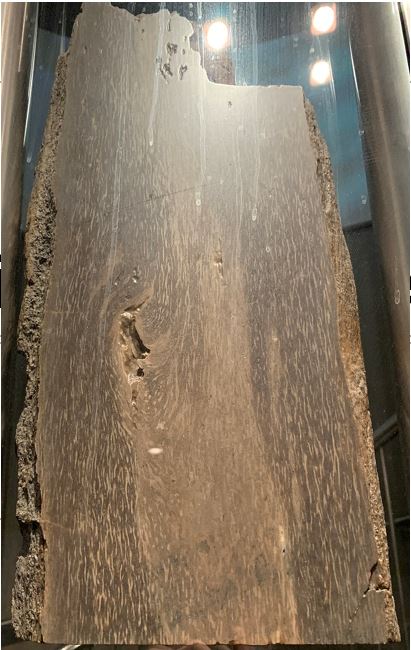
Prototaxites
By Bloopityboop – Own work, CC BY-SA 4.0, https://commons.wikimedia.org/w/index.php?curid=148464769
Global Collembola
by Juliane Filser, 08.02.2023
It's been a long way, and today finally we're happy to share this article:
https://www.nature.com/articles/s41467-023-36216-6#author-information
by Juliane Filser, 21.12.2021
Until now I used to tell my students that the largest number of legs in millipedes ever counted was 750, as reported for the species Illacme plenipes in 2006 in Nature. Apparently Marek never stopped searching for more, as now he and his team found a new species in a cave in Australia which almost doubles the record: Eumillipes persepone has as many as 1,306 legs!
Read on Nature.com: https://www.nature.com/articles/s41598-021-02447-0
by Juliane Filser,17.10.2022
A lot of underground feeding in temperate grasslands revealed our new review, a follow-up of the KEYSOM project:
Read on Nature.com:
https://www.nature.com/articles/s41598-022-21563-z
by Jan Lorenz-Fohrmann, 02.04.2019
It does not come quite surprising, but it is shocking nonetheless. In the same manner as insects, insectivorous birds are declining, e.g. in Denmark by up to 28%. Moreover, a shift can be examined from diverse specialist birds towards diet generalists. Of course, the biodiversity catastrophe does not brake for pretty species such as birds, so it is on us all to save what can still be saved!
Read in the Wiley Online Library: https://onlinelibrary.wiley.com/doi/full/10.1111/cobi.13307
by Jan Lorenz-Fohrmann, 20.02.2019
This brand-new review is the latest reminder on the alarming condition of our important insect fauna. According to this, 40% of species are immediately threatened by extinction! Time to change something, if we do not want bumblebees and dragonflies to be our grandchildrens Tyrannosaurus rex...
Read on ScienceDirect: https://www.sciencedirect.com/science/article/pii/S0006320718313636
by Jan Lorenz-Fohrmann, 19.02.2019
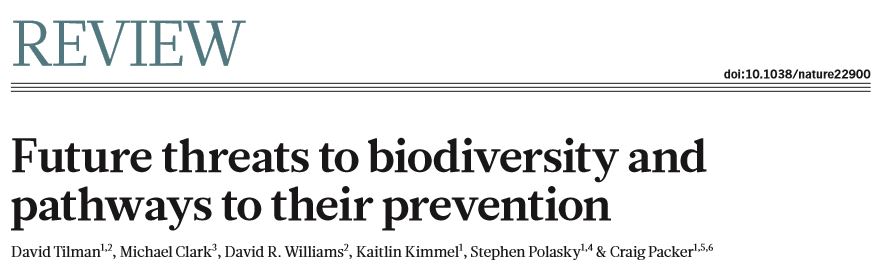
This article, published in Nature, gives an impression of the wide variety of threats biodiversity these (and coming) days is facing. But also, it features some ideas on how we can preserve it!
Read on Nature.com: https://www.nature.com/articles/nature22900
by Jan Lorenz-Fohrmann, 18.02.2019
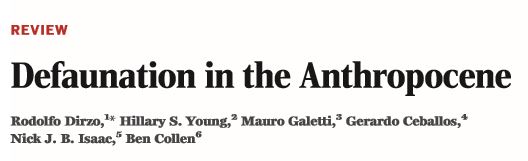
This review, published in Science, impressively shows the dramatic global losses in fauna and their impact on ecosystem functioning and human well-being. An average decline of 25% in living species can be measured in all living animal species; in invertebrates, declines occured in 67% of species, but with an average degree of 45%.
Read on the Science Website: http://science.sciencemag.org/content/345/6195/401
by Jan Lorenz-Fohrmann, 20.02.2019
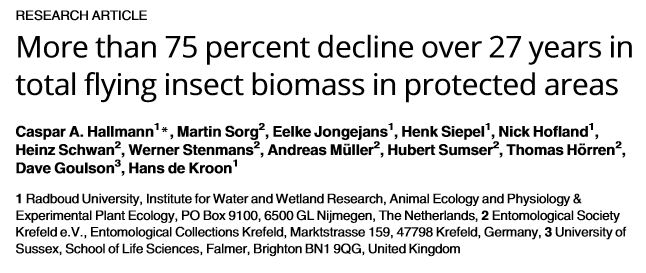
For this study, changes in insect biomass over a timespan of 27 years have been observed. The alarming result: There have been declines of 76 % or even more, even in protected areas!
Read on plos.org: https://journals.plos.org/plosone/article...
by Jan Lorenz-Fohrmann, 19.02.2019
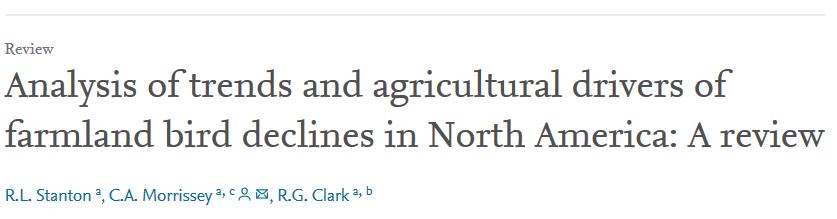
This review from 122 studies deals with the severe declines in bird species. 74% of farmland-associated bird species have decreased since 1966, in extreme cases by up to 39,5%. The reason: Intensification of agriculture, in particular insect mortality due to pesticide usage...
Read on ScienceDirect: https://www.sciencedirect.com/science/article/pii/S016788091730525X
By Jan Lorenz-Fohrmann, 20.02.2019
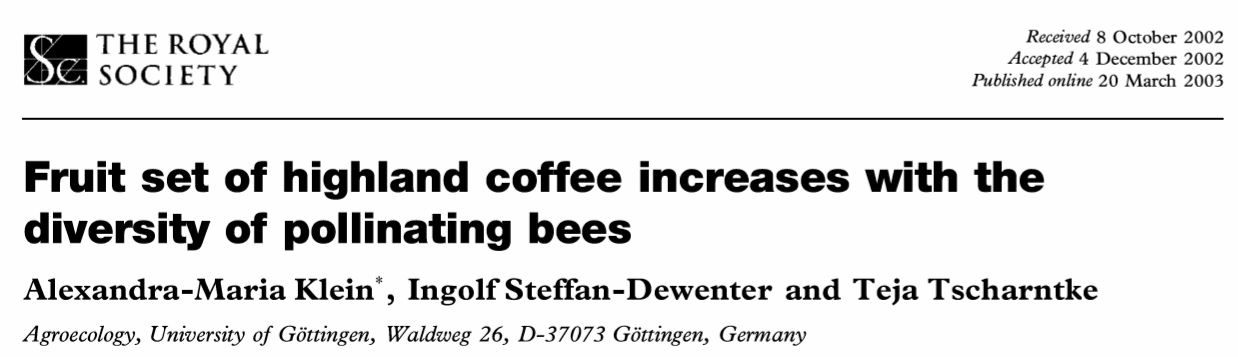
For this study, A. M. Klein and her colleagues have studied traditionally and intensively managed coffee farms. The pleasing result: A diverse pollinator community, rather than just a rich one, can provide the best yields, indicating that efficiency and sustainability do not necessarily have to contradict each other.
Read on The Royal Society's website: https://royalsocietypublishing.org/doi/abs/10.1098/rspb.2002.2306
0 Kommentare