

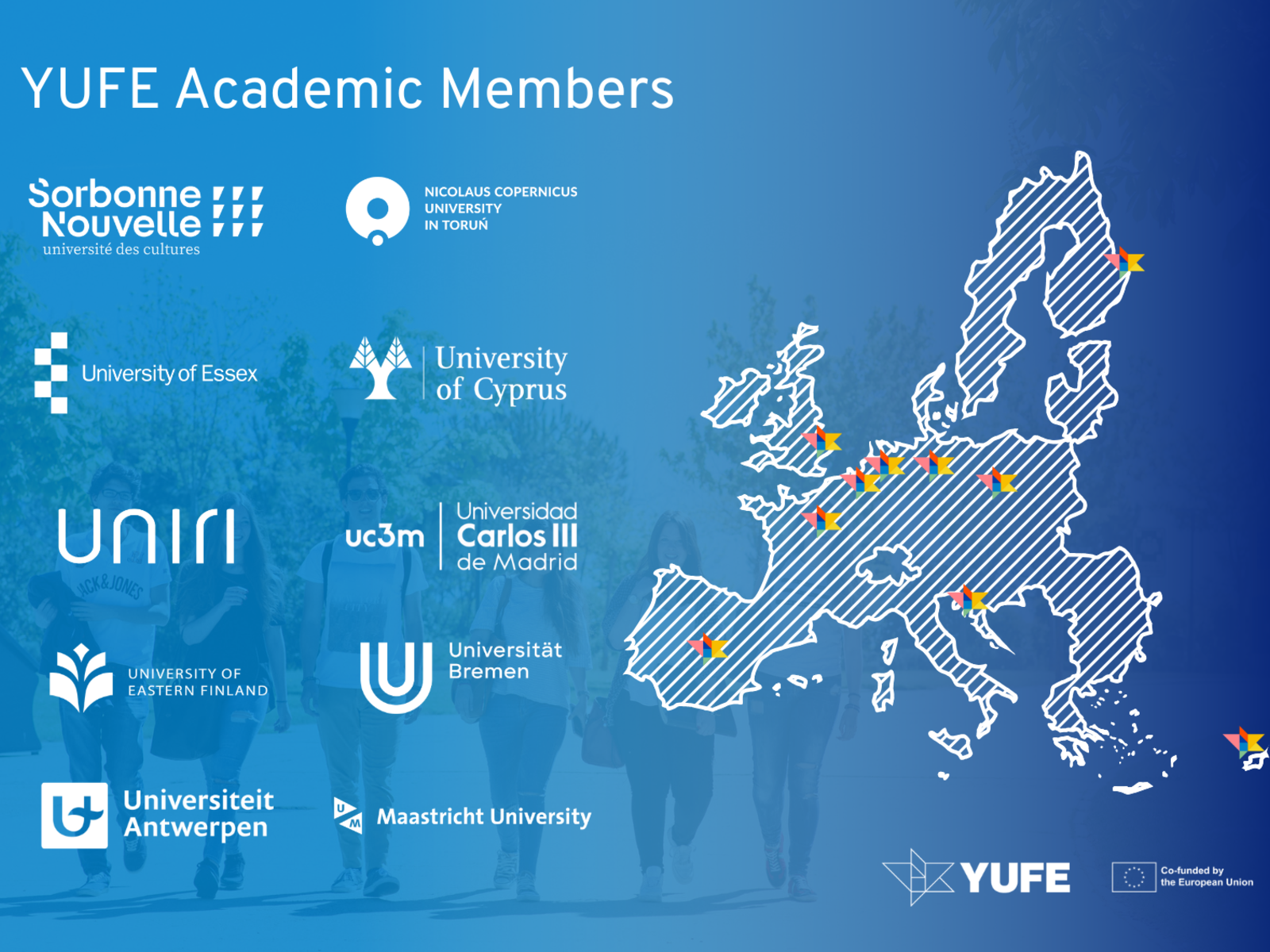
by Svenja Renner — Image: © YUFE
Enthusiasm for international teaching and collaborative teaching, interested colleagues, openness, a passion for new ideas, and support for European teaching initiatives—YUFE offers all of this. YUFE (Young Universities for the Future of Europe) is the European Alliance in which the University of Bremen, together with nine other universities, is reimagining European higher education. It sounds like an ambitious goal – but only with great ambition does the idea of a European university stand a chance of becoming a reality.
Opening Up Your Own Teaching to YUFE – Here’s How
YUFE offers international teaching on three different levels: from individual courses to pre-structured thematic packages (minors) to the accredited joint YUFE bachelor’s degree program in Urban Sustainability Studies. The opportunities for designing teaching within the YUFE context are broad and diverse:
Offering dedicated courses for YUFE students requires a relatively manageable amount of effort but already makes a significant contribution to the YUFE program. A stable course offering with English as the language of instruction and the option for virtual participation is not only a valuable resource within the YUFE context but also contributes to “internationalization at home” and greater flexibility in academic pathways.
Another option for making teaching with international and collaborative aspects attractive to both teaching staff members and students is to involve YUFE colleagues from partner universities in one’s own event or to jointly develop a new teaching event or module. Gaining new perspectives and inspiration for one’s own teaching and offering teaching jointly results in an increase in thematic knowledge, social skills, perspectives, and opportunities for reflection on the students’ side.
Those who group several modules under a single thematic umbrella, complete them with virtual offerings and those from other partner universities, and incorporate elements of challenge-based learning1Challenge-Based Learning involves interdisciplinary, practice-oriented questions – ideally posed by external stakeholders and addressed collaboratively by students (https://www.yufe.eu/students/yufe-minor/). have already taken the first steps toward a so-called YUFE Minor. This creates a pre-structured one-semester program with several elective options; students can pursue it as an independent semester abroad or as part of the YUFE bachelor’s degree program.
In addition, the YUFE bachelor’s degree program in Urban Sustainability Studies is a new, jointly accredited degree program with an open curriculum approach2The Open Curriculum approach enables students to create an individualized learning path and, within the YUFE context, allows them to choose three different minors and the elective coursesincluded in them (https://www.yufe.eu/yufe-bachelor’s degree/#prev).. It draws on the diverse offerings of the YUFE partner universities, already includes joint courses, and serves as an excellent platform for developing and effectively implementing collaborative European and international teaching. Students have access to a wide variety of mobility opportunities that allow them to get to know multiple university locations with their respective teaching and learning cultures and to experience the European ideal first-hand.3The YUFE partner universities have signed a joint Erasmus+ Agreement. Physical mobility generally takes place with financial support from Erasmus+ scholarships.
Blended Intensive Programs: Make You Want More
The growing number of innovative Blended Intensive Programs4Erasmus+ short-term mobility programs combine in-person participation (5–30 days) with several virtual components:https://www.uni-bremen.de/erasmus/blended-intensive-programmes. (BIPs) demonstrates how short-term mobility fits into flexible and international study paths. The joint design of a BIP by at least three international partners automatically reinforces the aspects of collaborative and international teaching. Experience has shown that a BIP leads to a condensed and intensive teaching experience – for teaching staff members and students.
Dr. Dennis Redeker from ZeMKI5Centre for Media, Communication and Information Research; Platform Governance, Media, and Technology Lab has already gained extensive experience in the development and implementation of BIPs within the YUFE context, for example, in the Blended Intensive Program “Challenges and Futures of the Governance of Platforms and AI”6See: https://platform-governance.org/2026/erasmus-bip-on-platform-and-ai-governance-hosted-at-the-university-of-bremen/ . Together with his ZEMKI colleague Dr. Rebecca Scharlach7Centre for Media, Communication and Information Research; Lab for Platform Governance, Media, and Technology and other colleagues from the universities of Antwerp, Carlos III de Madrid, Sorbonne Nouvelle in Paris, and Oberta de Catalunya, he designed the program and implemented it in Bremen. He summarizes his specific experiences as follows:

“Collaborative international teaching broadens one’s horizon. It allows me to question my own assumptions about good teaching, which are often shaped by institutional norms or my own discipline. Occasionally, my experience and expectations at the University of Bremen and within my own academic system encounter a completely different philosophy in teaching practice with international colleagues
– for example, regarding course design, the selection of examination formats, or the assessment of student performance. This coming together of different teaching and learning cultures is always very productive for me. Particularly within the YUFE context, we now have a well-established alliance of partners with whom we can maintain a dialogue on these issues over several years and develop joint formats that build bridges between the academic systems and the various disciplines involved. Furthermore, the young universities that come together in the YUFE Alliance are quite similar in many respects and share a common outlook on academia and society, which is certainly helpful when planning new projects. Joint international teaching goes hand in hand with new ideas in research and collaborative research projects, fully in line with Humboldt’s educational ideal of the unity of research and teaching.” (Dr. Dennis Redeker, ZeMKI, University of Bremen)
Becoming Part of YUFE
Whatever form it takes, teaching that is jointly developed and offered in an international context holds enormous potential – for teaching staff members, for students, and for the university as an institution. YUFE supports, connects, and promotes these efforts at the European level – get in touch with us and get involved at YUFE !
*Liebesbrief = German for “love letter”. Multilingualism: Multilingualism is a core value for YUFE. While English is the common working language within the alliance, students and staff have access to a wide range of language learning opportunities. In addition to English-language courses, teaching in the various national languages is also included in YUFE’s curriculum.
Fußnoten
- 1Challenge-Based Learning involves interdisciplinary, practice-oriented questions – ideally posed by external stakeholders and addressed collaboratively by students (https://www.yufe.eu/students/yufe-minor/). ↩︎
- 2The Open Curriculum approach enables students to create an individualized learning path and, within the YUFE context, allows them to choose three different minors and the elective coursesincluded in them (https://www.yufe.eu/yufe-bachelor’s degree/#prev). ↩︎
- 3The YUFE partner universities have signed a joint Erasmus+ Agreement. Physical mobility generally takes place with financial support from Erasmus+ scholarships. ↩︎
- 4Erasmus+ short-term mobility programs combine in-person participation (5–30 days) with several virtual components:https://www.uni-bremen.de/erasmus/blended-intensive-programmes. ↩︎
- 5Centre for Media, Communication and Information Research; Platform Governance, Media, and Technology Lab ↩︎
- 6
- 7Centre for Media, Communication and Information Research; Lab for Platform Governance, Media, and Technology ↩︎


