
„What I read is that there were even names, 1,500 names, commemorating the people that died in the world wars. For you to say I’m taking exactly the same monument and repurpose or redefine its meaning by adding four or five sentences, is that enough? And those are the questions that are asked, and there are questions that should still be asked so that they can be engaged with. […] How do you take something that is so colonial and you are going to decolonize it? How do you do that? How do you decolonize something that is intertwined with colonialism? It’s a very huge task. So, for me, those are very serious gaps.“
– Martha Akawa, Historian
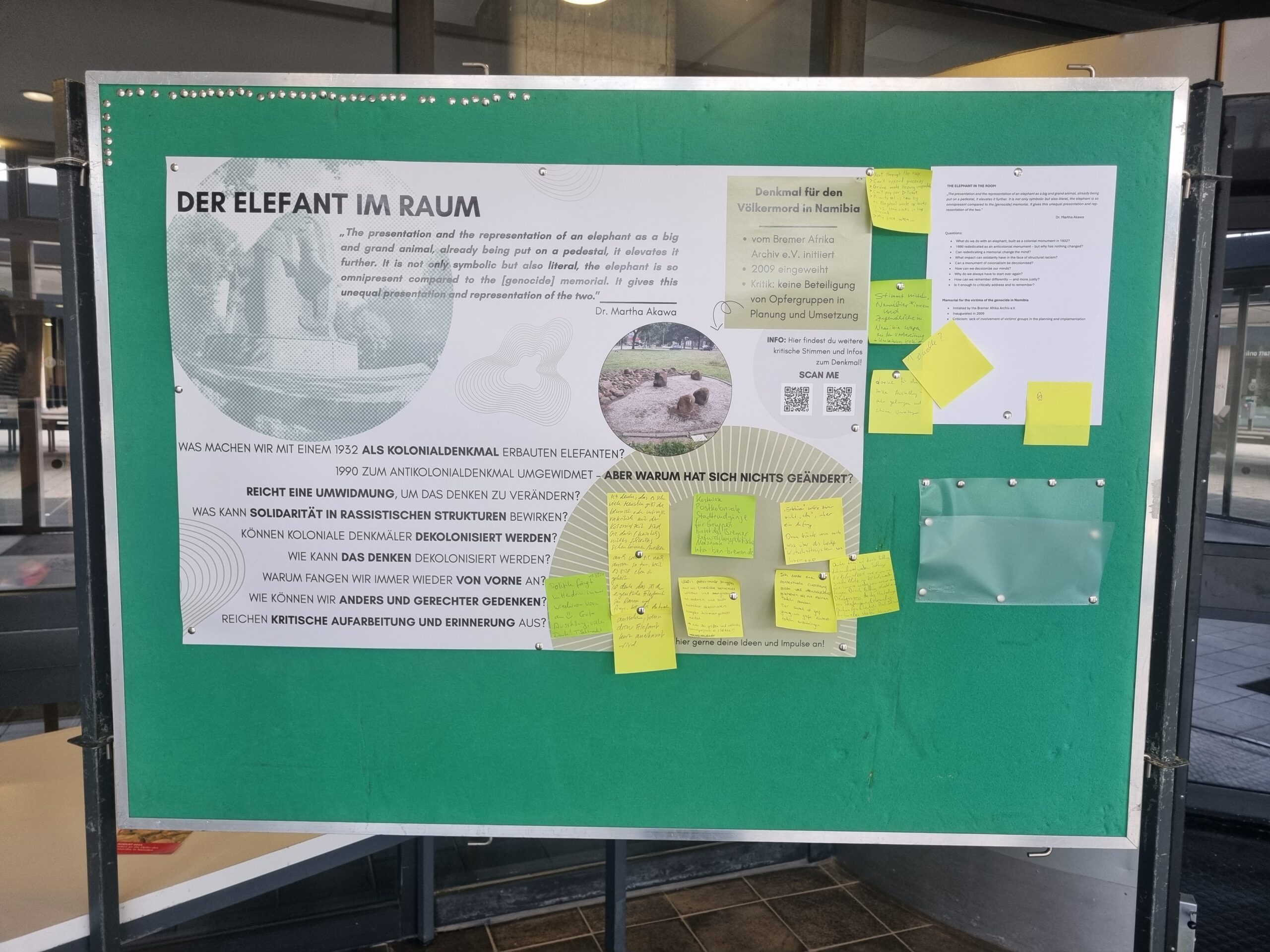
The Elephant was built in 1932 as a colonial memorial. In 1990, it was re-designated as an anti-colonial monument with a few sentences, additioning a memorial plaque. In 2009, on the initiative of the BAA e.V. and designed by Thomas Gatter, longtime chairman of the association, a memorial for the genocide of the Ovaherero and Nama was erected. The elephant, in its monumentality and size, symbolically represents the presence and dominance of colonial thought. From its elevated position on a pedestal, it overlooks the memorial. Yet, next to the elephant, the memorial—a stone circle on the ground nearby—appears almost unnoticed and neglected.
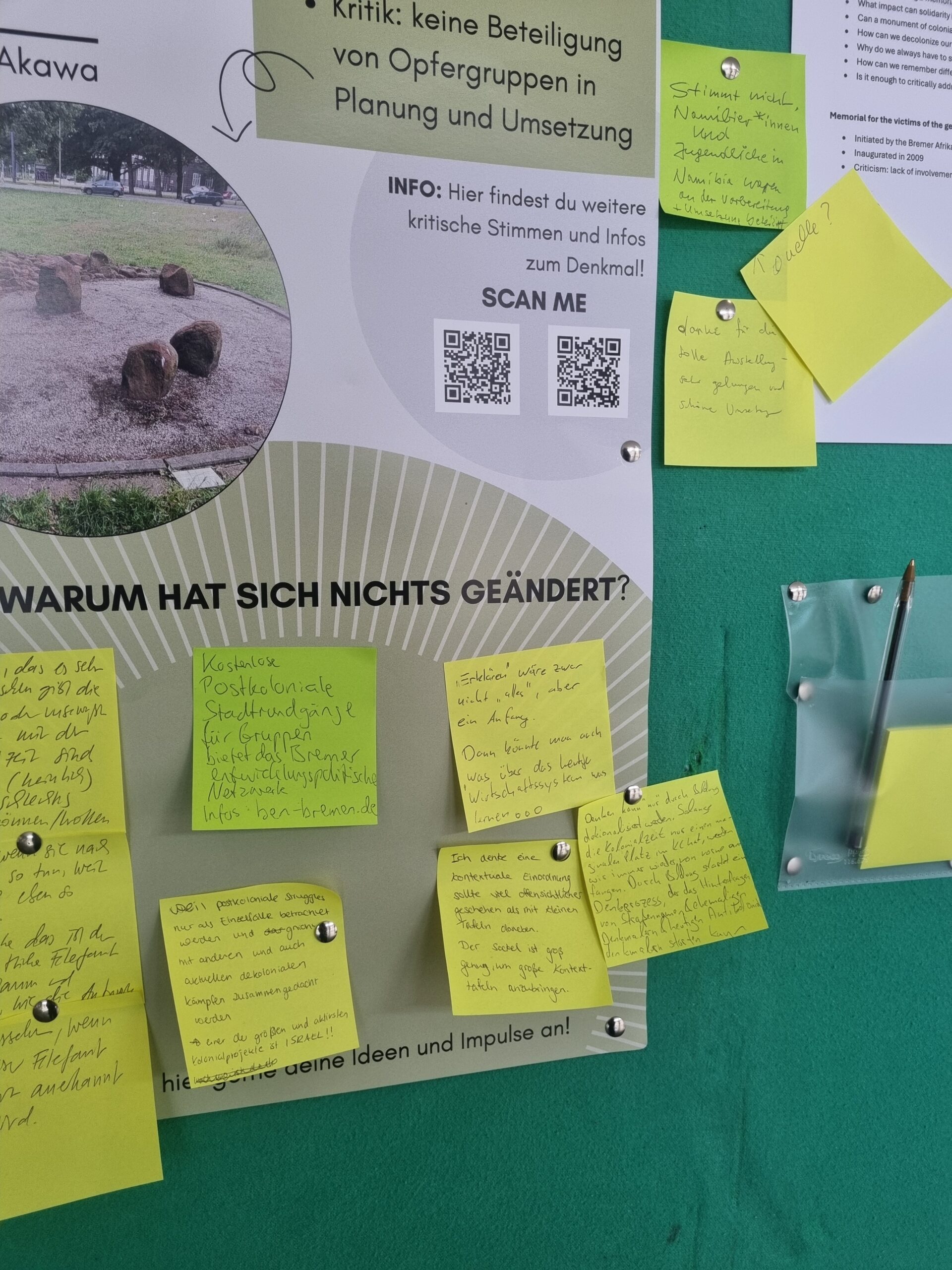
The exhibition poster was part of the exhibition „Solidarity in (Post-)Colonial Spaces?“, which was on display from July 5 to 25, 2025, at the State and University Library Bremen. Visitors were encouraged to interact with the poster and the questions it raises by attaching their own questions, ideas, comments, or critiques in the form of Post-Its. In the aftermath of the exhibition, the notes were documented on this blog.
Schreibe einen Kommentar